Google Ads for Dentists in Ontario: Get More Implant and Invisalign Patients
What Ontario Dental Clinics Actually Get From Working With Us
Before the strategy breakdown: here is what the work looks like in practice.
A Mississauga dental clinic came to us sending all of their Google Ads traffic to their homepage. Their conversion rate was sitting below 2%. We rebuilt the campaign around a dedicated implant landing page with cost transparency and a single call-to-action. Conversion rate moved above 8% within the first month. Same ad spend. Different structure.
A Vancouver clinic audit (covered in our Google Ads for Dental Clinics in Canada guide) found that 42% of their monthly spend was going to job-seekers and students because they had no negative keyword list. That is not an unusual finding. In Ontario dental accounts we audit, 25-35% of wasted spend typically traces back to broad match pulling in queries that have nothing to do with booking a patient.
The pattern is consistent: most underperforming dental Google Ads accounts do not have a budget problem. They have a structure problem.
If your campaigns have been running for 90+ days and you do not know your cost-per-new-patient by service type,reach out for a free audit before you spend another month finding out the hard way.
Who This Is For
This playbook is written for Ontario dental clinic owners and practice managers running Google Ads, or considering it. It covers campaign segmentation, keyword strategy, landing page requirements, RCDSO compliance, Ontario specific CPC benchmarks, and what professional management actually does month to month.
If you are spending over $1,500/month on Google Ads with fewer than 8 new patient calls/month to show for it, the answer is almost certainly structural not budget.
Why Ontario Dental Is the Most Competitive Google Ads Market in Canada
Among all clinic verticals physiotherapy, chiropractic, optometry, dermatology dental generates the highest CPCs in Canadian Google Ads. Three structural factors drive this.
Patient lifetime value is genuinely high. A patient who starts with an emergency visit and stays for 10 years of general dentistry, a crown, and eventually implant work is worth $15,000-$40,000 in lifetime revenue. That math makes Ontario clinic owners willing to pay more per click than almost any other health services category, which pushes CPCs up across the entire auction.
Corporate dental groups treat PPC as a primary acquisition channel with no per-location budget ceiling. A DSO operating 40+ Ontario locations is not worried about what one implant lead costs in North York. They are buying market share. Independent practices compete in the same auction with a fraction of the spend.
Ontario's dental market density is unusually high. A significant share of the population pays out of pocket for cosmetic and elective procedures, particularly in the GTA. That creates a dense, high-spend market where competition for the same patient is intense across Toronto, Mississauga, Brampton, Hamilton, Ottawa, London, Vaughan, Markham, and every major corridor between them.
The GTA dental Google Ads market is simply not comparable to running ads for a dental clinic in a mid-sized Canadian city outside Ontario. CPCs reflect that.
Ontario Dental Google Ads: What You'll Actually Pay Per Lead
Based on active campaigns managed in 2025-2026
General Dentistry
Cost per click: $8 to $18
Conversion rate: 5 to 9%
Cost per lead: $90 to $200
Emergency Dental
Cost per click: $10 to $20
Conversion rate: 8 to 14%
Cost per lead: $70 to $140
Invisalign
Cost per click: $15 to $28
Conversion rate: 3 to 6%
Cost per lead: $200 to $400
Dental Implants
Cost per click: $20 to $45
Conversion rate: 3 to 6%
Cost per lead: $250 to $500
GTA vs. Secondary Markets
These are GTA-weighted figures. Secondary Ontario cities (Hamilton, Ottawa, London) typically run 20 to 35% lower on CPCs but also carry lower search volume. The economics shift accordingly.
Why Implant Leads Are Worth It
A single implant case generates $4,000 or more in revenue. Even at the higher end of these benchmarks, the return on ad spend justifies the acquisition cost but only when the campaign is structured correctly and the landing page converts.
A Note on RCDSO Compliance
Ontario dental clinics advertising on Google must comply with RCDSO regulations. This is not optional and it is not the ad platform's problem to flag for you.
What you cannot do in Ontario dental ads: use superlatives ("best," "top-rated," "#1"), quote patient testimonials in ad copy, offer incentives like "free whitening" (prohibited in Ontario), or make clinical guarantees ("painless," "guaranteed results").
What performs well and stays compliant: factual, action-oriented copy. "New patients welcome. Evening appointments available. Direct insurance billing." addresses the actual logistical concerns patients have and tends to outperform inflated credentialing copy anyway. Compliant copy is not a constraint it is usually better copy.
The Structural Problems That Kill Most Ontario Dental Campaigns
One campaign for everything. A new patient searching "dentist near me" on a Tuesday afternoon is not the same person searching "dental implant cost Ontario" at 11pm. Running one campaign with one budget and one landing page for both means your implant budget subsidizes clicks from people who want a basic cleaning and will not pay out of pocket for anything.
Measuring cost-per-click instead of cost-per-patient. If a click costs $15 and your conversion rate is 5%, your cost-per-lead is $300. If 1 in 4 leads books and shows up, your cost-per-new-patient is $1,200. If that patient is a full arch implant case worth $25,000+ over the treatment relationship, $1,200 is reasonable. If they are coming in for a $180 cleaning, it is not. Most dental clinics we audit cannot tell you their cost-per-new-patient by service type.
Sending traffic to the homepage. Your homepage is a brochure. It is built for multiple audiences existing patients, people checking hours, referrals looking you up. A new patient who clicked an implant ad in Mississauga needs a page built for that exact intent. The Mississauga case above illustrates what happens when you fix this: a 4x improvement in conversion rate on the same ad spend.
No negative keyword list. Broad match is Google's default. Left unmanaged, an implant campaign will show for "dental assistant salary," "free dental care Ontario," and a dozen other queries that burn budget without producing patients. Building a negative keyword list before launch is the first thing a properly structured campaign does. This is the core of what we cover in our 3 fatal Google Ads budget mistakes article.
Campaign Segmentation: The Structural Fix
Run three distinct campaign groups with separate keywords, bids, ad copy, and landing pages.
Campaign 1: High-Value Cosmetic and Restorative (Implants, Invisalign, Veneers)
This is where patient lifetime value is highest and where budget should concentrate if you want the campaign to be self-funding. Implant patients found through paid search are often comparing multiple clinics, so the landing page needs to do real persuasive work cost factors addressed clearly, clinician credentials or case volume documented, and a single next step.
Target intent-heavy terms: "dental implant consultation Ontario," "all-on-4 implants Toronto," "cost of dental implants Mississauga." These are expensive per click, but the patient value justifies it when the landing page converts.
Campaign 2: Emergency and Urgent Care
Emergency dental searches carry the highest intent of any dental query. Someone typing "emergency dentist open now Brampton" or "cracked tooth Toronto" is not comparison shopping. The campaign runs on immediacy same-day availability, phone number in the ad, call extensions front and center. The landing page is simple: your number, your hours, and confirmation that you can see them today.
Emergency patients who have a good experience often convert to long-term general dentistry patients. That changes the lifetime value math for this campaign significantly.
Campaign 3: General Dentistry and New Patient Acquisition
Targets broader terms: "dentist accepting new patients [city]," "family dentist [area]," "dental checkup [neighbourhood]." CPCs are lower than implant terms but intent is more diffuse. The landing page focuses on the new patient experience, insurance acceptance, and what to expect on a first visit. This campaign generates volume, not the highest value per patient budget it accordingly.
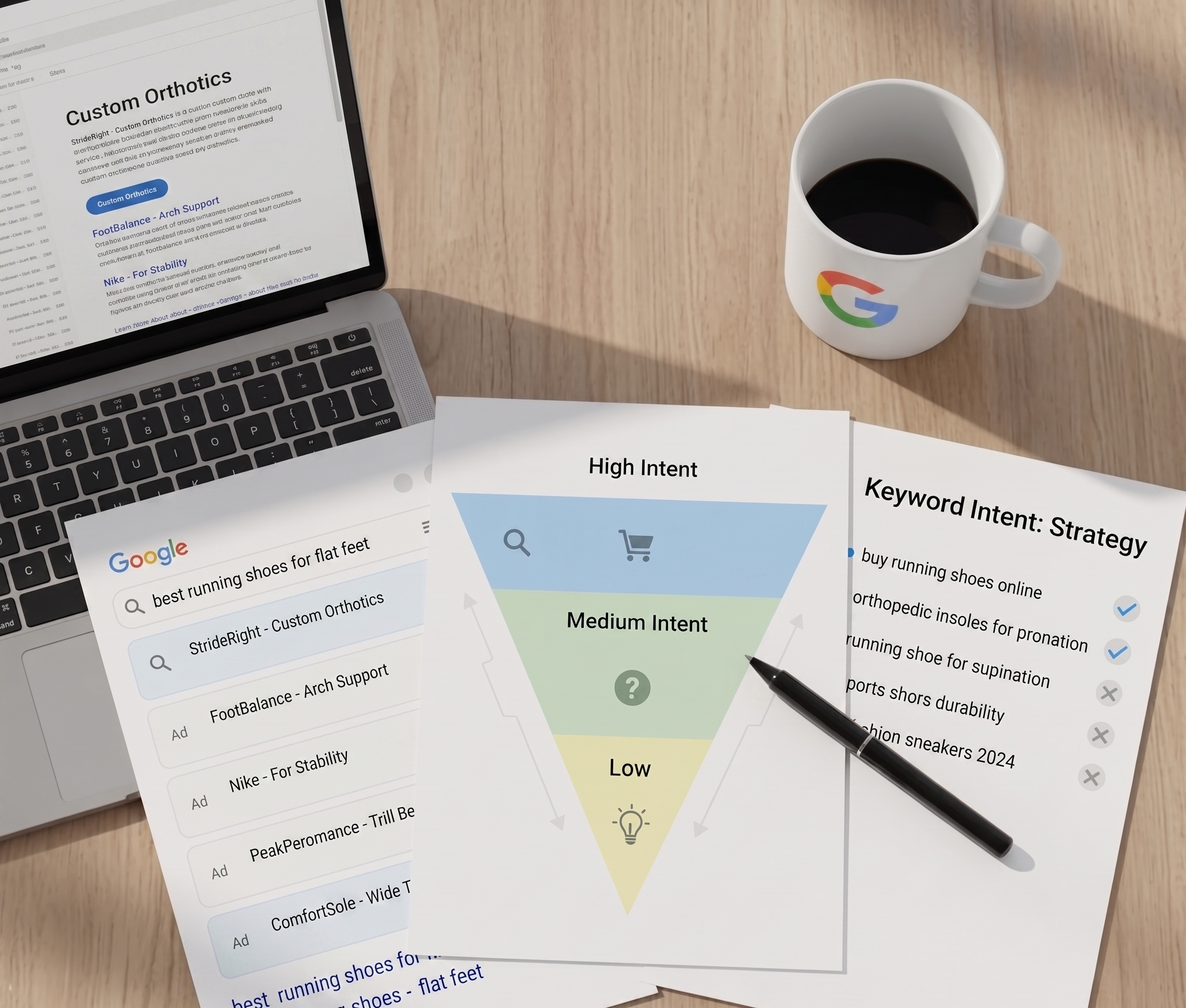
Keywords: High-Value Patients vs. Budget Drains
Target: High-Value Keywords That Actually Book
"dental implant cost Ontario" They're researching options and close to booking
"all-on-4 dental implants Toronto" They know the procedure, just comparing clinics
"Invisalign consultation Mississauga" In-market and price-aware
"emergency dentist open Saturday GTA" Urgent need, books immediately
Use Carefully: Medium-Intent Searches
"dentist accepting new patients Oakville" Switching or new to area, not urgent but actively looking
Avoid: Low-Intent Tire-Kickers
"how much do veneers cost" Not ready to book, just gathering data
"why does my tooth hurt" Looking for free advice, not a clinic
Block the Waste: Negative Keywords to Add
Add negatives for: "how to," "DIY," "can I," "at home," "free," "salary," and "school."
In Ontario dental accounts we audit, 25 to 35% of wasted spend comes from these slipping through on broad match.
Add negative keywords for "how to," "DIY," "can I," "at home," "free," "salary," and "school" before your campaign launches. In Ontario dental accounts we audit, 25-35% of wasted spend traces to these query types slipping through on broad match.
Ad Copy That Books Appointments
Most dental ad copy is interchangeable. "Accepting New Patients," "State of the Art Facility," "Family-Friendly Team." A patient scanning four ads sees the same four headlines.
Copy that converts does three things: confirms the patient is in the right place, reduces the next step to one action, and addresses the most common hesitation for that service type.
For implants: the hesitation is cost. "Clear Implant Pricing. No Hidden Fees." outperforms generic credentialing copy for patients who have already researched enough to know implants are expensive.
For emergency: the hesitation is availability. "Open Today Until 8PM. Emergency Slots Available." converts better than "Experienced Emergency Dental Team" because it answers the actual question.
For new patients: the hesitation is often switching uncertainty. "New Patients Welcome. Easy Transfer from Your Current Dentist." addresses that directly.
Use all available extensions: call extensions, location extensions, sitelinks to service pages, and callout extensions for direct billing. Ontario patients who can direct-bill dental insurance are meaningfully more likely to book.
Landing Page Requirements
One job: convert the visitor into a call or a booked appointment.
Headline match: If they clicked an implant ad in Mississauga, the first thing they read should confirm "Dental Implants in Mississauga." Mismatched headlines lose patients immediately.
Above the fold: Phone number visible without scrolling. Booking form or CTA button accessible without scrolling. No navigation menu pulling attention away.
Trust signals tied to the specific service: For implants, this means clinician credentials and documented case volume if you have it. For general dentistry, neighbourhood-specific reviews are more persuasive than aggregate star ratings.
Cost transparency: Ontario patients research costs heavily before visiting. A page that explains cost factors bone grafting requirements, number of implants, restoration type and gives a realistic range produces better-quality leads than "contact us for pricing," even if volume is slightly lower.
One primary action: Call or complete the booking form. Not both equally weighted. Not five options.
What Professional Management Looks Like Month to Month
Month 1: Full account audit or build from scratch. Campaign segmentation by service type. Ontario specific keyword research and CPC data. Negative keyword list built before a dollar is spent. Landing pages reviewed or built. Conversion tracking set up properly call tracking tied to specific campaigns and keywords, form submissions tracked as actual conversions not page views.
Months 2-3: Bid adjustments by device, time of day, and location. GTA dental queries have identifiable peak windows emergency searches spike Fridays and weekends, elective searches concentrate weekday evenings. Ad copy variants tested. Search term reports reviewed weekly with new negatives added.
Month 3+: Cost per new patient calculated by service type. Budget shifted toward highest return campaigns. Seasonal adjustments for Ontario peaks January and September are historically high-search periods for Invisalign. Campaign structure refined based on what is actually converting.
What professional management does not do: set budgets and leave them unchanged for months, ignore search term reports, or report on clicks as a proxy for results.
For context on how this approach differs from standard clinic Google Ads management across other Canadian markets, our Google Ads for Clinics in Toronto guide covers cross-clinic CPC benchmarks.
What to Expect on Budget and Fees
On ad spend: a minimum of $1,500-$2,000/month is required to gather statistically meaningful data in most Ontario markets. Below that threshold, you are averaging too few clicks per week to make reliable bid or copy decisions. For implant focused campaigns in Toronto or Mississauga, $3,000-$5,000/month in ad spend gives enough volume to optimize properly.
On management fees: professional Google Ads management is a separate cost from your ad spend. The right answer on structure (flat fee vs. percentage of spend) depends on your budget and campaign complexity. We discuss this directly during the audit call there are no generic packages here because a $1,500/month implant-only campaign requires a different setup than a $5,000/month multi service account.
If you want a realistic cost per booked appointment estimate for your specific Ontario market before committing to anything,that is what the free audit is for.
Should You Run Google Ads or Focus on SEO First?
For most Ontario dental clinics in competitive GTA markets, organic SEO takes 12+ months to produce meaningful new patient volume from search. Google Ads can produce inbound calls within 2 weeks of a properly structured launch.
That said, Google Ads is an amplifier, not a fix. If your website has no service pages, loads slowly, or has a low Google Business Profile rating, ads will accelerate those problems not solve them. A clinic with a 3.2-star rating spending $40 per implant click is burning money.
For clinics with total monthly budgets under $1,500, we typically recommend building an SEO foundation first. Organic traffic does not carry a per-click cost, which makes it a better long-term investment at lower budgets. Our article on whether Google Ads is the right move for your business walks through the readiness checklist in plain terms.
Decision Framework: Act Now vs. Fix First
When to Act Now
Website: Functioning site with clear service pages, trust signals, and booking options
Services: High-value treatments like implants, Invisalign, cosmetic work
Capacity: Room for 10 to 20 new inquiries per month
Market: Competitive GTA market where organic SEO takes 12+ months
Response: Direct phone line, fast follow-up during business hours
When to Fix First
Website: No service pages, no trust signals, no booking mechanism
Services: Low-margin general dentistry only, no upsell path
Capacity: Schedule full, no room for new patients in next 60 days
Market: No baseline data on where current patients come from
Response: Calls go to voicemail, form submissions go unfollowed
FAQ
-
Yes. Sending paid traffic to your homepage is the most common and most expensive structural mistake in dental Google Ads accounts. A homepage is built for multiple audiences. A landing page has one job: convert the visitor who clicked a specific ad. The difference in conversion rate between a homepage destination and a service-specific landing page is not marginal -- it is typically 3x to 5x in our experience.
-
It depends on the service and the landing page. Emergency dental can convert at 8-14% because intent is urgent. Implant and Invisalign campaigns with dedicated landing pages typically run 3-6%. General dentistry new patient campaigns run 5-9%. If your conversion rate is below 2% on any campaign, the landing page is almost always the issue, not the keywords.
-
Performance Max works for high-value services like implants and Invisalign, but only when you have enough conversion data to feed the algorithm. The threshold is roughly 30-50 conversions per month. Below that, the algorithm does not have enough signal and the campaign tends to chase cheap, low-intent traffic. Start with standard Search campaigns, build conversion volume, then consider layering Performance Max.
-
They serve different timelines. Google Ads produces calls within weeks. SEO in competitive Ontario dental markets takes 12+ months to show meaningful organic patient volume. For a clinic in a dense GTA market that needs new patients now, Google Ads is the faster lever. For a clinic with a longer runway and a limited budget, SEO builds compounding returns that do not carry a per-click cost. Running both in parallel is the strongest long-term position.
-
It depends on your budget, service mix, and market. A properly structured implant campaign in Toronto spending $3,000/month in ad spend should produce 8-15 qualified implant consultations per month, assuming a landing page that converts at 3-5%. A general dentistry new patient campaign at the same spend should produce more volume at a lower value per patient. We build a realistic forecast for your specific market during the audit that is a better anchor than an industry average.
-
Google Local Services Ads (LSAs) appear above standard search ads and charge per lead rather than per click. For dental clinics they are useful for high-intent local queries like "dentist near me," but they have limited targeting by service type and require a strong Google Business Profile review count to rank. Standard Google Search Ads give you full control over keywords, ad copy, and landing page routing making them the better option for service-segmented campaigns targeting implants, Invisalign, or cosmetic work specifically. Running both in parallel is reasonable for practices with sufficient budget.
-
Track cost-per-new-patient by service type. That requires call tracking tied to specific campaigns and keywords, form submission tracking that counts actual completions not page views, and a monthly review of how many leads booked and showed up. If your reporting stops at impressions, clicks, or even cost-per-lead, you are missing the only metric that matters. A campaign driving 30 leads at $120 per lead is not performing if 5 book and they are all coming in for a $180 cleaning.
-
You can. The question is what the learning curve costs in a high-CPC market. A self-managed account in competitive Ontario dental typically spends 3-6 months and several thousand dollars reaching the configuration a professionally built account starts at. If you want to test self-management, start with a tightly geo-targeted campaign for one service, cap your daily budget, and measure cost per new-patient not cost-per-click.
What to Do Next
If your current dental Google Ads account has been running for 90+ days and you do not know your cost per new patient by service type, that is your first action. Pull that number. It will tell you whether you have a budget problem, a structure problem, a landing page problem, or a conversion problem and which one to fix first.
If you are starting from scratch, do not launch a single general campaign with a homepage destination. Build the segmentation before you spend a dollar.
Free Google Ads Audit for Ontario Dental Clinics
Step 1: Reach out via the form or call directly tell us what you are spending and which services you want to grow.
Step 2: We schedule a 30-minute account review at a time that works around your clinic hours.
Step 3: We audit your campaigns, landing pages, and conversion tracking against the Ontario dental competitive landscape.
Step 4: You get a straight answer what is working, what is not, and where your competitors are outbidding you. We will also give you a realistic cost-per-booked-appointment estimate for your market. No pressure to proceed.
Anthony Yang
Hi, I’m Anthony, the founder of Elescend Marketing. Over the past three years, I’ve worked with more than 50 small businesses across North America.
Today, I lead a highly skilled SEO and SEM team. We work closely with local business owners to help them maximize their profit on a limited budget. My focus is on delivering real, measurable results, not empty promises. Visit my LinkedIn profile.